We use cookies to ensure that we give you the best experience on our website.
Login
Sign Up
Coinsteam Business
Utilize the invoice payment gateway for checkout – order now, pay later. With a Coinsteam business account, you gain access to priority support, increased order limits, and competitive pricing for bulk orders available through quote requests.
Invoice Gateway : Upon placing your order, we will issue an order invoice followed by an invoice payment request, featuring a convenient payment gateway. Choose from flexible payment options including PayPal, Venmo, Apple Pay®, credit cards, debit cards, or ACH bank transfers.
Thank you for being a valued customer. We're looking forward to build steam for your projects.
Gaussian Splatting and AI Are Rewriting 3D Creation’s Rules
From Superman's holographic aliens to Zillow home tours, Gaussian splatting and AI-powered 3D tools are reshaping an entire industry at breakneck speed.
When Framestore needed to bring Superman’s Kryptonian parents to life as shimmering holographic beings, the VFX studio turned to a technology that didn’t exist three years earlier — and captured two-minute continuous takes using 192 synchronized cameras generating twenty million 3D data points per frame.
The technique is called Gaussian splatting, and it has crossed the threshold from academic curiosity to production weapon faster than almost any graphics technology in history. In 2023, a team at INRIA published a paper and open-source codebase that demonstrated real-time, photorealistic 3D scene rendering without traditional polygons. By early 2026, the method had accumulated 1,692 research papers on arXiv in a single year, attracted over $1.3 billion in venture capital, and landed native support in both the Khronos glTF standard and Pixar’s OpenUSD format. The 3D industry noticed. Then it scrambled to keep up.
The (Processing) Level Required to Be Super
We’ve had clients ask us whether our 3D/4DGS capture and processing pipeline holds up in high-end VFX cinematic shots. Last year we were fortunate to work on the Superman production with Framestore (capturing Superman’s parents for a… pic.twitter.com/d1e8rjMASf
That scramble is no longer hypothetical. Gaussian splatting — alongside a wave of AI-powered 3D generation tools — is rewriting the rules for how three-dimensional content gets made, viewed, and delivered. And the pace is accelerating.
What Gaussian Splatting Actually Does
Traditional 3D relies on polygons — triangles and quads stitched into meshes, then wrapped with textures and lit with simulated light. Photogrammetry, its real-world capture cousin, reconstructs those meshes from photographs. Both approaches have served the industry for decades, and both share a fundamental constraint: they rebuild structure first, appearance second.
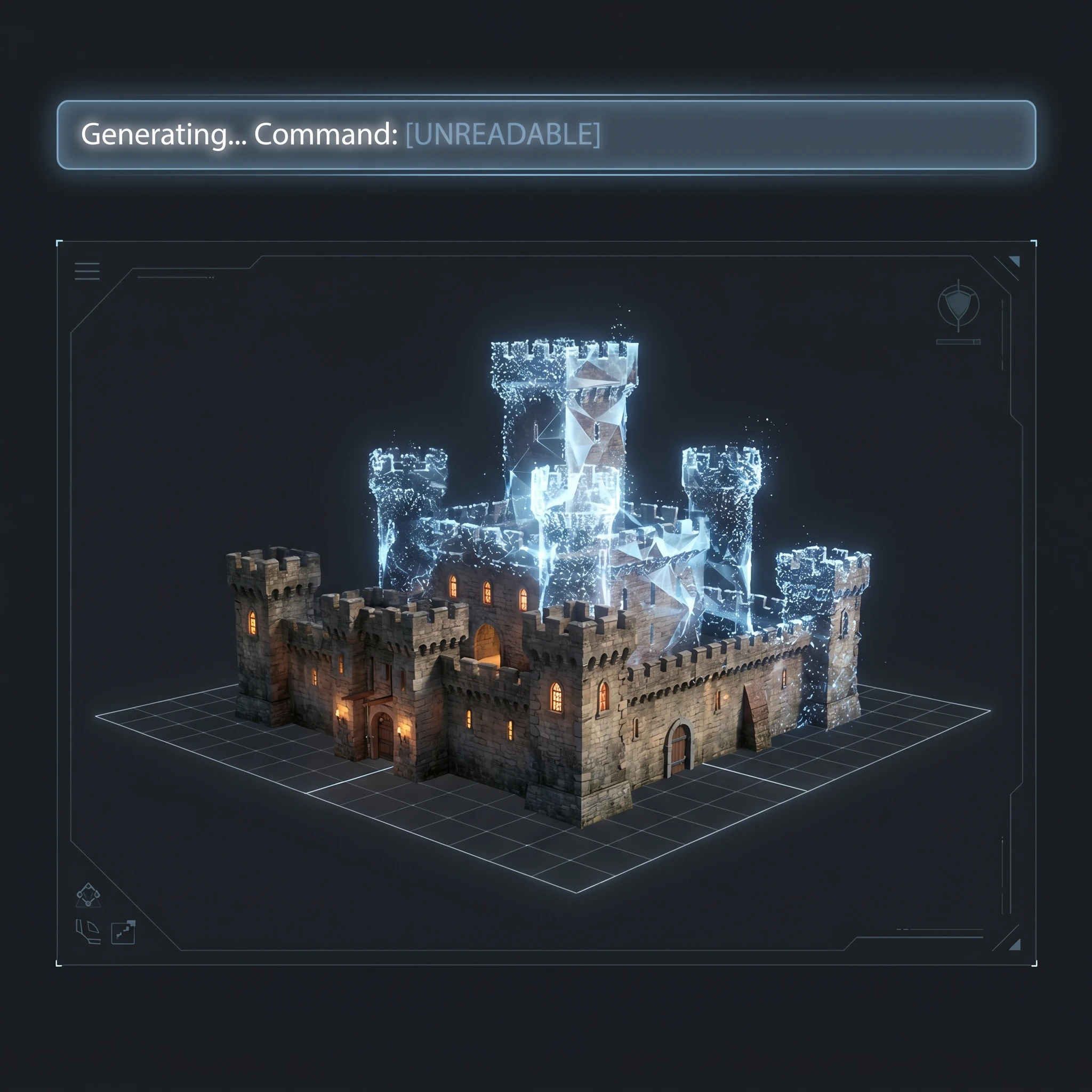
Gaussian splatting flips that priority. Instead of constructing geometry, it represents a scene as millions of tiny, soft 3D blobs called Gaussians. Each blob carries position, size, rotation, color, and transparency data. Combine millions of them, and they blend into a rendering that looks startlingly close to a photograph — but in navigable, full 3D.
The process starts with ordinary photographs or video. Multiple images of a scene from different angles feed into a system that builds a rough point cloud, replaces those points with Gaussian blobs, then optimizes each blob until the combined output matches the original photos as closely as possible. There is no manual modeling, no UV unwrapping, no texture baking. The system learns how the scene looks from every angle and stores that knowledge inside the blobs themselves.
Why It Beat NeRF
Neural Radiance Fields (NeRFs) achieved similar visual quality years earlier, but rendering a single new viewpoint required expensive ray-marching computation — roughly five frames per second on consumer hardware. Gaussian splatting replaced that bottleneck with GPU-friendly rasterization, the same fundamental approach game engines use. The result: 100+ FPS on a consumer GPU, with visual fidelity that rivals offline rendering. Photorealism went real-time almost overnight.
Gaussian Splatting
NeRF
Photogrammetry
Rendering Speed
100+ FPS (real-time)
~5 FPS
Pre-rendered only
Training Time
77 sec–30 min
Hours to days
Hours
Visual Quality
Near-photorealistic
Near-photorealistic
Varies with cleanup
Geometric Accuracy
~7.8 cm mean error
Similar to GS
±1–2 mm (LiDAR-grade)
Output Format
Splat point cloud
Neural network weights
Polygon mesh + textures
Real-Time Navigation
Yes
No
No
From Lab to Blockbuster in Three Years
Superman (2025) marked the first time dynamic 4D Gaussian splatting appeared in a major motion picture. Framestore collaborated with Infinite Realities to capture actors Bradley Cooper and Angela Sarafyan on a specialized stage surrounded by 192 machine-vision cameras firing at 24 frames per second. The resulting volumetric data — roughly twenty million splats per frame, cropped and cleaned to six million — produced holographic sequences with visible hair strands, subsurface skin properties, and eye reflections that responded to post-production camera moves. No polygon mesh could have delivered that level of organic detail at that speed.
🚀We're bringing Gaussian Splats to glTF with Khronos Group, Open Geospatial Consortium, Esri & Cesium. This is how open standards win. Let’s build the future of 3D together.
But Hollywood was not the only industry paying attention. Zillow launched SkyTour in July 2025, using Gaussian splatting to generate drone-like 3D exterior views of home listings — interactive fly-arounds accessible on a phone or laptop. DJI shipped native Gaussian splatting in Terra V5.0, processing up to 30,000 drone images per job for enterprise mapping clients. Esri added Gaussian splats as a native 3D layer type in ArcGIS Pro 3.6, georeferenced to authoritative coordinate systems. Foundry built a dedicated SplatRender node into Nuke 17.0, making splats first-class citizens in professional compositing pipelines.
The training speed kept collapsing. The original 2023 implementation required roughly thirty minutes on a high-end GPU. By early 2026, FastGS — a CVPR 2026 highlight — trained a full scene in 77 seconds, a 15x acceleration on certain datasets. Apple open-sourced SHARP, a model that converts a single photograph into a navigable 3D Gaussian splat in under one second, rendering at 100+ FPS with metric-accurate scale. Users on Apple Vision Pro reported walking into their own phone photos as explorable 3D memories.
The Money Follows the Math
Luma AI — raised $900 million in a November 2025 Series C, reaching a $4 billion valuation and $1.07 billion in total funding. Investors include AMD Ventures, Andreessen Horowitz, and Amazon.
World Labs — founded by AI pioneer Fei-Fei Li, raised over $1 billion (including $200 million from Autodesk) at a roughly $5 billion valuation as of February 2026. Its Marble platform generates spatially coherent 3D worlds from images, video, or text.
Tripo AI — secured $50 million in March 2026, backed by Alibaba and Baidu Ventures, for a native 3D diffusion model that produces engine-ready assets in two seconds.
Gracia AI — raised $1.7 million to bring dynamic 4D Gaussian splatting to standalone VR headsets like Meta Quest 3, delivering streamable volumetric video in the browser with no app required.
The broader 3D scanning market — valued between $5 and $6.7 billion in 2025 — is projected to reach $19 to $22 billion by 2030. Professional Gaussian splatting services already command 1.5x standard photogrammetry rates, with project pricing ranging from $2,250 to $50,000 depending on scope.
AI Is Reshaping All of 3D, Not Just Capture
Gaussian splatting solved the capture-and-render problem. But a parallel revolution is underway in 3D generation itself — creating assets, worlds, and animations from text prompts, single images, or minimal input.
Stability AI’s Stable Fast 3D transforms a single image into a 3D asset in half a second — 1,200 times faster than its predecessor. Meta’s 3D Gen pipeline produces fully textured objects with physically-based rendering materials from a text prompt in under sixty seconds. Google DeepMind’s Genie 3, publicly available since January 2026, generates minutes of explorable 3D environments at 720p and 24 FPS from text alone.
We built Spark 2.0 to bring the most ambitious 3DGS worlds to the web🌍
Making high-fidelity 3D accessible on any device is a big step for spatial storytelling. We’re proud to share this open-source renderer capable of streaming 100M+ 3DGS to unlock a new era of world building! https://t.co/xOPplRgXc6
NVIDIA’s Edify 3D, showcased at GTC 2026, generates artist-ready meshes with clean quad topology, automatic UV mapping, and up to 4K PBR materials — collaborating with Adobe on Firefly integration and with Mattel on accelerating toy design. Autodesk launched Wonder 3D inside Flow Studio in March 2026, offering text-to-3D and image-to-3D generation trained on synthetic and licensed data. Meshy AI surpassed 30 million generated assets and 3 million users, earning recognition from Andreessen Horowitz as the only 3D tool on its “Most Popular AI Tools Among Game Developers” list.
On the animation front, UniRig — presented at SIGGRAPH 2025 — demonstrated a 215% improvement in automatic skeletal rigging accuracy over previous state-of-the-art methods, compressing a process that once took days into seconds. Roblox open-sourced Cube 3D, a foundation model for generating functional, interactive 3D objects from text. Unity shipped an AI Beta in 2026 with agentic capabilities that automate asset generation and workflow tasks directly inside the editor.
A Google Cloud survey of 615 game developers in August 2025 found that 90% were already using AI in their workflows, with 95% reporting that it reduced repetitive tasks. The generative AI market for 3D assets — valued at $2.47 billion in 2025 — is projected to hit $7.21 billion by 2029, growing at a 31% compound annual rate.
Standards Are Catching Up
For any technology to move from novelty to infrastructure, it needs standards. Gaussian splatting got two major ones within months of each other.
In February 2026, the Khronos Group announced KHR_gaussian_splatting, a glTF 2.0 extension that stores Gaussian splat data — position, rotation, scale, transparency, spherical harmonics — in the industry’s most widely adopted 3D interchange format. A companion compression extension, based on Niantic’s open-source SPZ format, achieves 90% file size reduction (a 250MB PLY file shrinks to roughly 25MB). Google, NVIDIA, Apple, Autodesk, and Bentley Systems all backed the effort.
One month later, the Alliance for OpenUSD shipped a native Gaussian splat schema in OpenUSD v26.03, developed by Pixar, Apple, NVIDIA, and Adobe. Gaussian splats now coexist alongside traditional USD primitives in the same scene graph — meaning a single production pipeline can mix polygon assets and splat data without conversion.
Game engines followed. NanoGS, a free Unreal Engine 5.6+ plugin released in March 2026, applies Nanite-style level-of-detail clustering to Gaussian splats, delivering a 4x viewport FPS increase. Unity’s Gaussian splatting renderer supports Metal and Vulkan, pushing 60 FPS for scenes under one million Gaussians on mid-range desktop hardware.
The Uncomfortable Questions
Speed and investment do not exist in a vacuum. The same forces compressing 3D creation timelines are compressing the workforce that built the industry.
Computer graphics artist job postings fell 12% in 2024 and another 33% in 2025 — two consecutive years of decline. In Q1 2026, the tech industry laid off nearly 80,000 employees, with almost half of those cuts explicitly linked to AI and automation. The Association of Illustrators reported that over 32% of respondents had lost work to AI, averaging roughly $12,000 in lost income per affected artist. More than 30 VFX studios have closed or collapsed in recent years, a trend accelerated by tightening budgets and AI-driven workflow consolidation.
Quality gaps persist, too. Only about one in ten AI-generated 3D assets are production-ready without manual rework, according to industry assessments from early 2026. AI-generated meshes frequently suffer from non-flat faces, inconsistent edge loops, and UV mapping issues that prevent clean rigging and animation. Gaussian splatting’s geometric accuracy — roughly 7.82 centimeters of mean error — works well for visualization but falls far short of the 1-2 millimeter precision that survey-grade LiDAR delivers for engineering and construction.
Legal battles are sharpening. Disney and Universal filed a 110-page lawsuit against Midjourney in June 2025, alleging the company trained on copyrighted characters without permission. The Allen Institute for AI’s Objaverse dataset scraped over 800,000 3D models from Sketchfab without creator consent, violating the platform’s “NoAI” tagging system. SAG-AFTRA ratified contract provisions in 2025 establishing the first-ever limitations on using performers’ work for AI training, and the Animation Guild secured pay increases tied to AI displacement protections.
Microsoft Research has warned of a subtler risk: the “hollowing-out of core expertise” as AI makes tasks cognitively easier. If entry-level modeling and texturing jobs disappear — and the data suggests they are disappearing fastest — the pipeline that develops senior talent narrows. The tools get smarter, but the humans who understand why those tools work the way they do become scarcer.
The Bottom Line
Every transformative technology in 3D has followed the same arc: initial fear, messy adoption, and eventual integration that expands the field rather than shrinks it. Photoshop did not eliminate illustrators — it created entirely new categories of digital art. Motion capture did not replace animators — it gave them a richer starting point. The transition from hand-drawn to CG animation at Pixar eliminated certain roles while creating thousands of others that had never existed before.
Gaussian splatting and AI 3D tools are following the same trajectory, but faster. A single photograph now becomes a walkable 3D environment. A text prompt generates a production-grade asset in two seconds. A 77-second training run produces what once required hours of manual reconstruction. These are not toys — they are force multipliers that lower the barrier to entry for independent creators, small studios, and entirely new industries like spatial computing that demand 3D content at a scale traditional pipelines could never deliver.
The concerns are real and deserve serious attention — particularly around fair compensation for artists whose work trained these systems, and around maintaining the human expertise that AI accelerates but cannot replace. But the direction is clear. The studios, standards bodies, and billion-dollar investors are not betting against 3D artists. They are betting that when those artists get tools this powerful, the things they build will be extraordinary.
The future of 3D is not polygons or splats, manual or automated, human or machine. It is all of the above — running at 100 frames per second.




Trending now