Utilize the invoice payment gateway for checkout – order now, pay later. With a Coinsteam business account, you gain access to priority support, increased order limits, and competitive pricing for bulk orders available through quote requests.
Invoice Gateway : Upon placing your order, we will issue an order invoice followed by an invoice payment request, featuring a convenient payment gateway. Choose from flexible payment options including PayPal, Venmo, Apple Pay®, credit cards, debit cards, or ACH bank transfers.
Thank you for being a valued customer. We're looking forward to build steam for your projects.
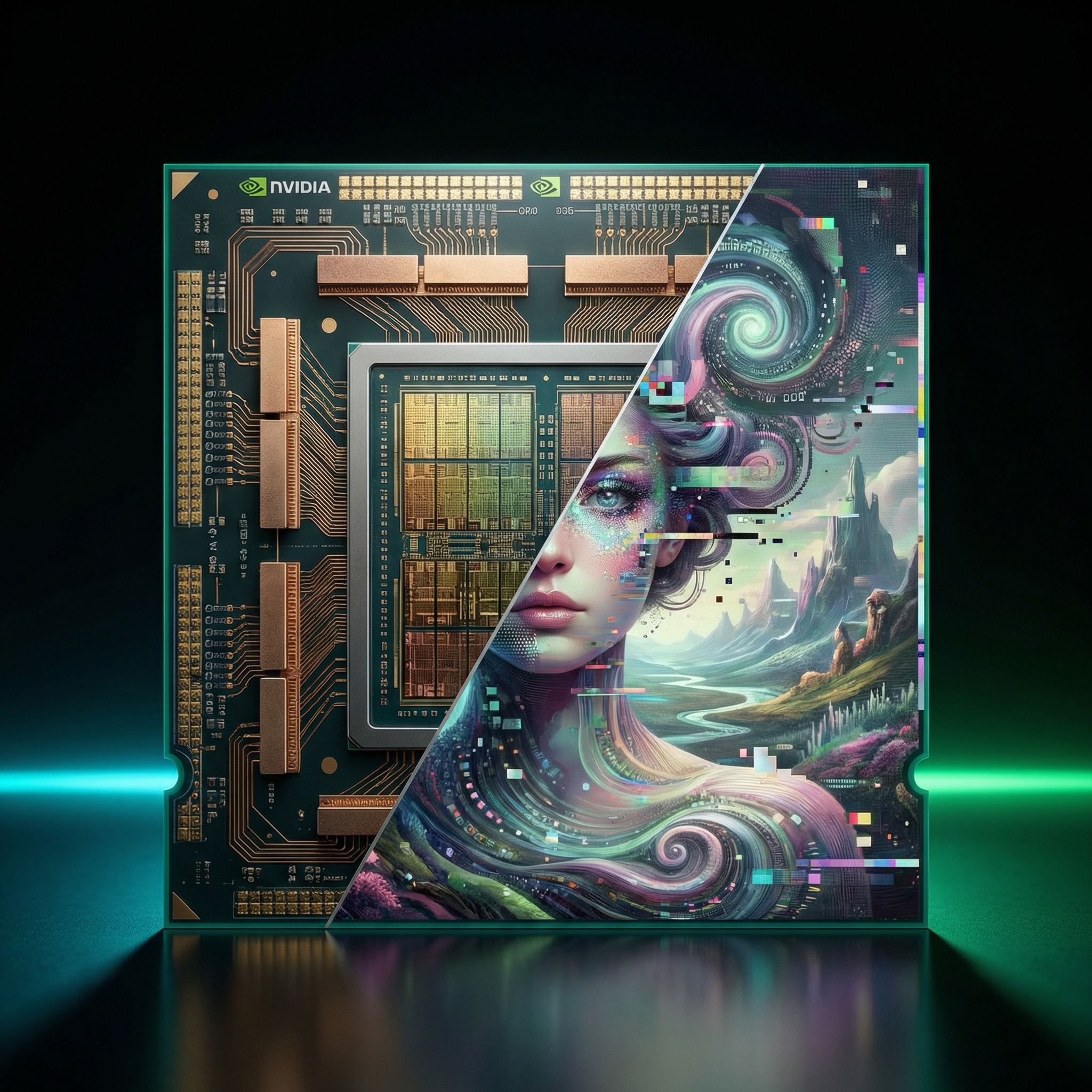
NVIDIA’s DLSS 4.5 Is Impressive, But It’s Masking a Hardware Problem
DLSS 4.5 delivers stunning upscaling and frame generation. But for AI workloads and rendering, the software magic vanishes and the hardware limitations become painfully clear.
NVIDIA’s DLSS 4.5 might be the most impressive display of AI-powered image reconstruction the gaming world has ever seen. But beneath the buttery-smooth frame rates and sharper-than-native visuals lies an uncomfortable truth: the company is using software wizardry to paper over a generation of hardware stagnation.
At CES 2025, NVIDIA unveiled the RTX 50 series alongside DLSS 4, making bold claims that turned heads across the tech industry. CEO Jensen Huang declared that the $549 RTX 5070 could deliver “RTX 4090 performance”—a statement that reviewers would later call “an absolute flat-out lie.” Now, with DLSS 4.5’s even more sophisticated AI upscaling and 6x frame generation, the picture is becoming clearer: NVIDIA has built a remarkable software layer that makes underpowered hardware look flagship-tier. For gamers playing DLSS-supported titles, that might be enough. For everyone else—AI developers, 3D artists, video editors, local LLM enthusiasts—the cracks are showing.
Credit where it’s due: DLSS 4.5 represents a genuine technological leap. The second-generation transformer AI model was trained using five times the compute of its predecessor, and the results are immediately visible. Side-by-side comparisons show dramatically improved sharpness, better handling of particle effects, and significantly reduced temporal artifacts—the distracting “boiling” effect that plagued earlier implementations.
In hands-on testing, switching between DLSS 4.0 and 4.5 models reveals instant improvements. Foliage that previously looked muddy now pops with detail. Comet trails behind moving objects are largely eliminated. Even at the aggressive “Performance” setting, image quality approaches what native rendering delivered just two years ago.
The new Dynamic Frame Generation is particularly clever. Rather than blindly generating fake frames whether you need them or not, it monitors your actual frame rate and only kicks in when performance dips below your target refresh rate. It’s designed to eliminate stutters during demanding scenes while prioritizing real frames whenever possible—addressing one of the core criticisms that frame gen opponents have leveled at the technology.
The Numbers Don’t Lie
But step outside the DLSS bubble, and the RTX 50 series tells a different story. Here’s what NVIDIA is actually selling you at flagship prices:
RTX 5090 — $1,999 (up $400 from RTX 4090), 32GB GDDR7, 21,760 CUDA cores. Native performance: approximately 30% faster than RTX 4090.
RTX 5080 — $999, 16GB GDDR7 (same VRAM as 4080 Super), 10,752 CUDA cores. Native performance: approximately 15% faster than RTX 4080 Super at the same price.
RTX 5070 Ti — $749, 16GB GDDR7, 8,960 CUDA cores. Gamers Nexus opened their review with a blunt recommendation: “Do not buy.”
RTX 5070 — $549, 12GB GDDR7, 6,144 CUDA cores. Native performance: barely 5% faster than RTX 4070 Super at 4K, while drawing more power.
The generation-over-generation gains are among the smallest NVIDIA has ever delivered. The RTX 5090’s 30% native improvement comes with an 18% price increase and substantially higher power consumption (575W TDP, requiring a 1,000W power supply). The 5080 and below offer even less compelling upgrades for anyone not leaning heavily on DLSS.
The controversy crystallized around one marketing claim: that the $549 RTX 5070 could match the $1,599 RTX 4090’s performance. When review embargoes lifted, the tech press responded with unusual unanimity.
Gamers Nexus called it “intentionally manipulative and a misrepresentation of reality.” Linus Tech Tips titled their review “This is a 4090 Killer… and I’m a Liar.” Independent benchmarks from TechSpot showed the RTX 4090 is approximately 45-57% faster than the RTX 5070 in native rasterization across 25 games tested at 1080p-4K.
The only way the claim approaches validity is with Multi-Frame Generation cranked to maximum—generating three AI frames for every one actually rendered. At that point, yes, the framerate counter shows similar numbers. But latency doubles. Artifacting increases. And you’re essentially comparing apples to AI-generated approximations of apples.
In Alan Wake 2 at 1440p, the RTX 4090 delivers 145fps with native rendering. The RTX 5070 can hit 131fps using MFG 4X—but with over twice the input latency. For competitive gamers, that’s not a comparison; it’s a disqualification.
The VRAM Problem Nobody’s Addressing
Perhaps the most glaring issue is VRAM allocation. NVIDIA’s choice to use 2GB GDDR7 modules has resulted in memory configurations that critics call “stingy” for 2025:
RTX 5080 — 16GB (unchanged from RTX 4080 Super)
RTX 5070 Ti — 16GB (unchanged from RTX 4070 Ti Super)
RTX 5070 — 12GB (unchanged from RTX 4070)
Only the RTX 5090 received a VRAM increase (32GB, up from the 4090’s 24GB). For gaming with DLSS, this might suffice—upscaling actually reduces VRAM pressure since you’re rendering at lower internal resolutions. But for workloads where DLSS doesn’t exist, 12-16GB is increasingly constraining.
The situation is severe enough that Chinese repair technicians have begun modifying RTX 5080s with 32GB of memory for AI workstation use—a hack that wouldn’t be necessary if the cards shipped with adequate VRAM in the first place.
When DLSS Doesn’t Apply
Here’s the elephant in the room: GPUs aren’t just for gaming anymore. The same hardware that runs Cyberpunk 2077 also powers local AI inference, Stable Diffusion image generation, Blender renders, DaVinci Resolve timelines, and machine learning experimentation. In these workflows, DLSS is irrelevant. There’s no magic AI upscaler for your 70B parameter LLM. No frame generation for your Octane render.
For these users, the RTX 50 series offers a stark value proposition:
AI/ML Training — The RTX 5070 Ti and 5080 both cap at 16GB VRAM. For deep learning, this is increasingly a “capacity-limited” scenario. Models that fit in memory run faster on the 5080, but models that don’t fit won’t run at all. According to Cloudzy’s analysis, “neither is enough for deep learning” at the prosumer level.
Local LLMs — Running quantized models locally requires VRAM. A 70B parameter model at Q4 quantization needs approximately 40GB—making even the RTX 5090 insufficient without offloading to system RAM (which dramatically reduces performance).
3D Rendering — Complex scenes with detailed textures can easily exceed 16GB. The RTX 5080’s 19% ray tracing advantage over the 5070 Ti is real, but VRAM constraints remain the bottleneck for professional work.
Video Production — 4K and 8K timelines with GPU-accelerated effects depend on raw compute and memory bandwidth, not AI upscaling.
NVIDIA’s Priorities Have Shifted
The writing has been on the wall for some time. During NVIDIA’s Q3 2025 earnings call, the company declared it has “evolved from a gaming GPU company to now an AI data center infrastructure company.” The financial reality supports this identity shift: data center revenue hit $51.2 billion in Q3 2025, while gaming brought in just $4.3 billion—a 12:1 ratio.
This isn’t just corporate messaging. According to reports from industry sources, NVIDIA plans to slash GeForce RTX 50 series production by 30-40% in early 2026. The cuts will target the RTX 5070 Ti and RTX 5060 Ti 16GB first—the cards that offer the best value for consumers.
The reason? Memory suppliers like Samsung and SK Hynix are prioritizing GDDR7 allocations for AI data centers over consumer GPUs. At the end of November 2025, Micron announced it was discontinuing its Crucial consumer memory lineup entirely to focus on AI hardware. Memory prices are expected to rise 30% in Q4 2025 and another 20% in early 2026.
Gamers aren’t just getting less hardware per dollar—they’re increasingly competing with hyperscalers for the hardware that exists at all.
The DLSS Tax
There’s an emerging argument that DLSS is being used not as a bonus feature, but as a crutch to mask insufficient raw performance. Features that make weak hardware look good are a double-edged sword: they democratize high-fidelity gaming, but they also let NVIDIA claim its flagship cards achieve 240fps in games that actually render at 60fps natively.
This creates a troubling precedent. If consumers accept that “RTX 4090 performance” means “RTX 4090 performance with three-quarters of the frames generated by AI,” NVIDIA has less incentive to deliver meaningful hardware improvements. Why invest in bigger dies, more CUDA cores, and additional VRAM when software can bridge the gap in marketing materials?
DLSS 4.5’s performance overhead underscores this tension. On RTX 50 and 40 series cards, the new transformer model costs 2-5% performance—acceptable given the quality gains. But on older RTX 30 and 20 series hardware, which lacks FP8 acceleration, users see 20%+ performance losses. The best new features increasingly require the newest hardware—even as that hardware delivers diminishing returns in raw capability.
G-Sync Pulsar: A Genuine Innovation
One bright spot in the announcement cycle is G-Sync Pulsar, a backlight strobing technology that NVIDIA claims delivers motion clarity equivalent to 1000Hz displays on conventional IPS panels. By using multiple horizontal backlight zones that pulse consecutively—similar to how CRTs drew images—Pulsar strobes all pixels for equal durations while maintaining variable refresh rate support.
Unlike previous ULMB implementations, Pulsar reportedly avoids the flickering and dimness that made earlier strobing technologies unpleasant. It’s available on select monitors from AOC, ASUS, MSI, and Acer—actual hardware innovation rather than software approximation.
The Bottom Line
DLSS 4.5 is genuinely impressive technology. The image quality improvements are visible, Dynamic Frame Generation is smart, and the new transformer model represents meaningful progress. For gamers playing supported titles on RTX 40 or 50 series hardware, it’s a legitimate upgrade worth enabling.
But that’s the limitation—it only matters for gaming, in supported titles, with compatible hardware. For the growing population of users who see GPUs as general-purpose compute devices, NVIDIA is charging more money for modest performance gains and stagnant VRAM allocations. The software magic that makes a $549 card look like a $1,600 one disappears the moment you open Blender, run a local LLM, or train a machine learning model.
NVIDIA has achieved something remarkable: convincing a generation of buyers that software-generated frames are equivalent to hardware-rendered ones. Whether that’s progress or misdirection depends entirely on how you use your GPU. For those who bought into the PC platform for its flexibility—to game today and render tomorrow and experiment with AI next month—the RTX 50 series increasingly feels like a gaming console with a premium price tag.
The AI boom has been very good to NVIDIA. For gamers and creators, the returns are less certain.


Trending now