Utilize the invoice payment gateway for checkout – order now, pay later. With a Coinsteam business account, you gain access to priority support, increased order limits, and competitive pricing for bulk orders available through quote requests.
Invoice Gateway : Upon placing your order, we will issue an order invoice followed by an invoice payment request, featuring a convenient payment gateway. Choose from flexible payment options including PayPal, Venmo, Apple Pay®, credit cards, debit cards, or ACH bank transfers.
Thank you for being a valued customer. We're looking forward to build steam for your projects.
AMD is set to release its latest high-performance processors, the Ryzen 9 9950X3D and Ryzen 9 9900X3D, on March 12th, priced at $699 and $599, respectively. These new Zen 5 X3D chips bring cutting-edge advancements in gaming and productivity performance, with the 9950X3D featuring 16 cores and 32 threads while the 9900X3D offers 12 cores and 24 threads. Both CPUs leverage second-generation 3D V-Cache technology, significantly increasing on-chip cache—144MB for the 9950X3D and 140MB for the 9900X3D—to minimize latency and boost gaming efficiency. With clock speeds reaching up to 5.7GHz and improved architectural refinements, these processors are shaping up to be AMD’s most badass desktop chips yet, delivering a major leap in efficiency, speed, and responsiveness for enthusiasts and professionals alike.
Architectural Advancements
The 9950X3D is built on AMD’s Zen 5 microarchitecture, which features significant refinements over Zen 4, particularly in branch prediction, instruction scheduling, and cache efficiency. Fabricated on TSMC’s 4nm process node, Zen 5 delivers a better power-to-performance ratio while increasing instruction throughput per cycle (IPC).
Zen 5 Upgrades:
Reworked Front-End: The instruction prefetcher has been improved, leading to lower latencies and better speculative execution. Zen 5 now has a deeper instruction window and wider execution units, allowing it to handle more simultaneous operations.
Enhanced L1 and L2 Cache: Each core now has 80KB of L1 cache (32KB instruction + 48KB data) and 1MB of L2 cache, reducing dependency on slower L3 cache for frequent memory access.
Better Out-of-Order Execution: AMD has increased the size of its reorder buffer, allowing for greater instruction parallelism, which translates into smoother performance in heavily threaded workloads.
Higher ALU Count: The number of Arithmetic Logic Units (ALUs) has increased from 4 to 6 per core, boosting integer processing performance—especially beneficial in physics-heavy gaming and AI-driven tasks.
AVX-512 Support: The inclusion of AVX-512 enables high-performance floating-point calculations, benefiting workloads such as machine learning inference, 3D rendering, and video encoding.
Second-Generation 3D V-Cache: Smarter and Faster
The 3D V-Cache technology in the 9950X3D has been significantly improved over its previous iteration. While the first-gen X3D CPUs suffered from thermal constraints due to the stacked cache design, this generation features a new placement that improves heat dissipation.
144MB Total Cache: This includes 128MB of L3 cache, a massive increase over the standard Ryzen 9 9950X, which only has 64MB.
Better Thermal Design: The 3D V-Cache chiplet now sits below the core dies rather than directly above, reducing hotspot formation and allowing the CPU to sustain higher clock speeds for longer periods.
Lower Latency: Thanks to its direct on-die connectivity, the new V-Cache configuration cuts access latency by up to 15%, reducing frame-time inconsistencies in gaming.
Optimized Clock Scaling: The new cache configuration allows the CPU to maintain near-peak boost clocks more often than the previous generation. This means less performance loss in non-cache-bound workloads, making it a more balanced CPU overall.
Performance Metrics and Real-World Gains
According to AMD’s internal benchmarks:
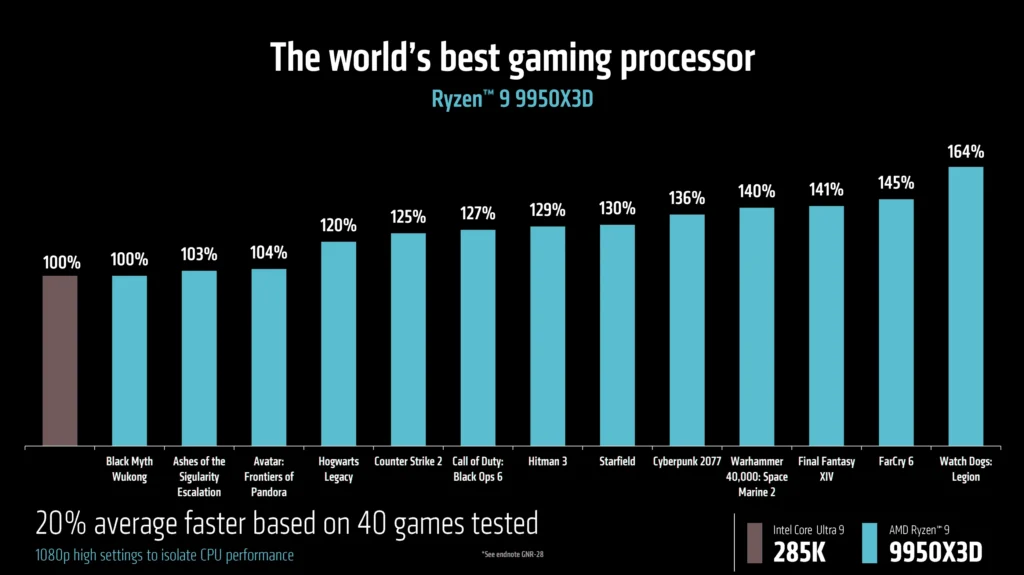
Gaming: The 9950X3D is 8% faster than the 7950X3D and 20% faster than Intel’s Core Ultra 9 285K in 1080p gaming.
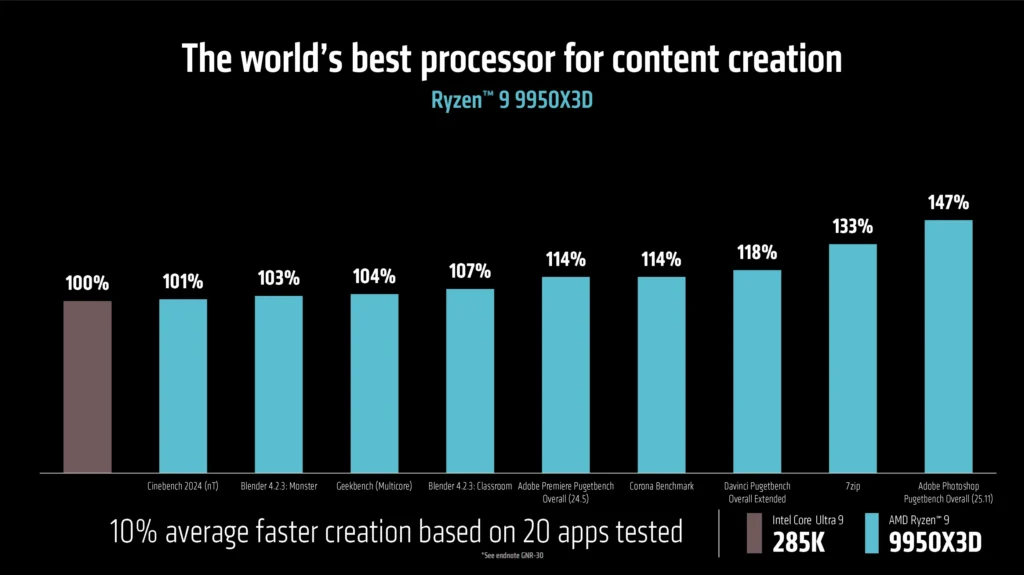
Content Creation: Performance in Adobe Photoshop and Blender sees a 13% improvement over its predecessor.
Multi-Core Workloads: Thanks to the improved cache hierarchy and ALU count, rendering tasks and software compilation speeds are up to 18% faster.
Notably, AMD’s CES 2025 presentation revealed that gaming performance is within 1% of the Ryzen 7 9800X3D, reinforcing a pattern seen in the previous generation where the 16-core X3D model was optimized for multitasking, while the 8-core X3D variant remained the absolute gaming king.
Inside AMD’s Development
The development of the Ryzen 9 9950X3D was led by AMD’s Chief Technology Officer and Executive Vice President, Mark Papermaster. With over 40 years of engineering experience, Papermaster has been instrumental in shaping AMD’s technical direction and product development. In his exclusive video series, “Advanced Insights,” which premiered on February 28, 2024, Papermaster delves into various technological advancements and industry trends, providing viewers with an insider’s perspective on AMD’s innovations.
AMD’s engineering team worked closely with TSMC to optimize the 4nm process, allowing them to increase transistor density by 28% over Zen 4, which translates into more cores, more cache, and better efficiency within the same thermal envelope.
A key challenge in developing Zen 5 was minimizing the latency penalties associated with stacked cache designs. Engineers used a new Through-Silicon Via (TSV) design to improve data flow between the core and cache layers, cutting interconnect delays by 12%.
With a March 12th release date, the only question left is whether supply will meet demand—or if this powerhouse will become yet another elusive piece of tech that enthusiasts scramble to get their hands on.






WHEN WILL U HAVE MORE INVENTORY
requiring 200 pcs K4ZAF325BC-SC20 please respond inquiry
AMD was killing the game, but i think next era will be ARM driven. Look out for Snapdragon.